

















Total Solar Eclipse 2026: First Photos of Totality Revealed
See the breathtaking first photos of the total solar eclipse 2026 as totality begins over Greenland. Watch the sun's glowing corona reveal itself now.

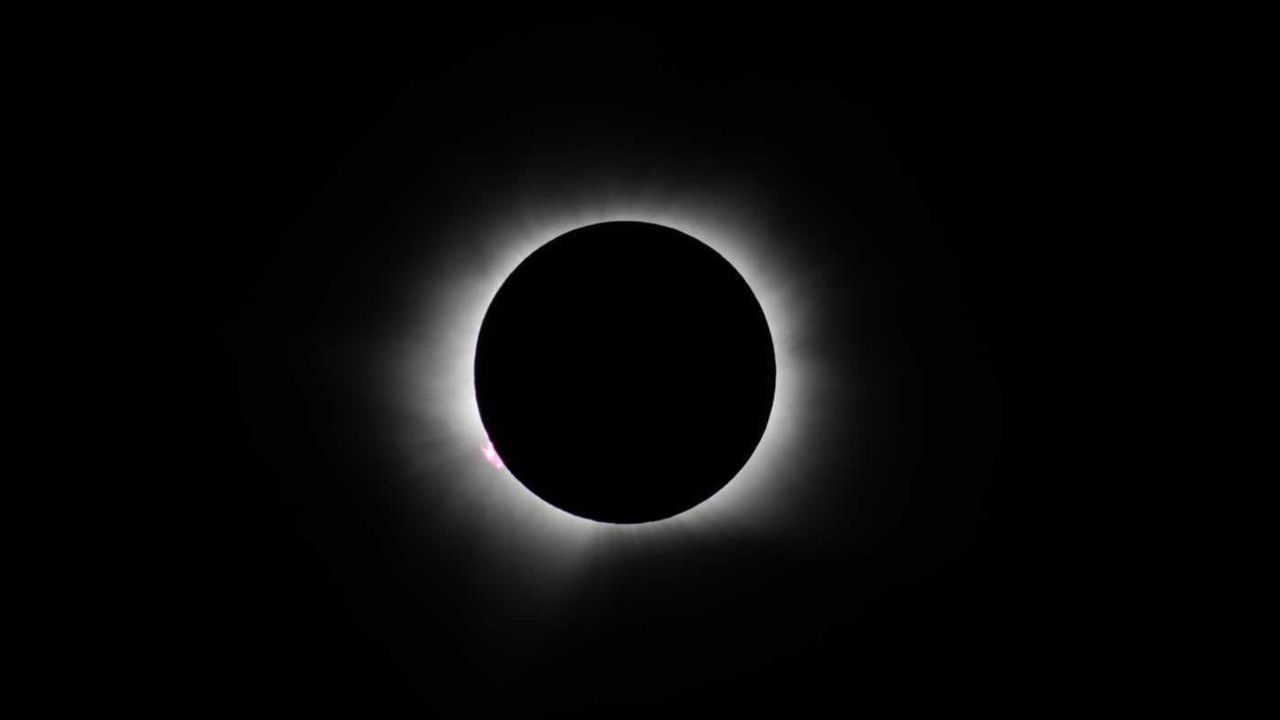
A spectacular total solar eclipse captivates onlookers across the Northern Hemisphere today as the moon blocks the sun, casting a dramatic shadow from the Arctic to the Mediterranean. The celestial event begins over the icy waters of Scoresby Sund, Greenland, where eager skywatchers witness the first moments of totality from vessels in the fjord. This rare alignment of the Earth, moon, and sun creates a breathtaking display of cosmic precision, drawing global attention as the shadow sweeps southeastward toward Europe before concluding off the northern coast of Africa.
Observers in the path of totality experience a sudden plunge into a surreal, false twilight as the moon's colossal silhouette swallows the sun. The immediate result is the brilliant emergence of the solar corona, the sun's outer atmosphere, which radiates outward in shimmering streams of plasma. Before the sun vanishes entirely, it transforms into an incandescent crescent, creating a dramatic countdown. Clear skies over Greenland allow for pristine viewing, enabling high-resolution photography of the corona's intricate structures that are normally invisible to the naked eye.
Total solar eclipses occur when the moon passes directly between the Earth and the sun, perfectly aligning to obscure the solar disk. While partial eclipses happen more frequently, totality is a localized phenomenon requiring onlookers to stand within a narrow path cast by the moon's shadow. The 2026 eclipse is particularly notable for its sweeping path, which cuts across remote Arctic regions, traverses several European nations, and offers a rare sunset eclipse for observers in Spain. This geographic trajectory presents unique viewing opportunities and challenges for those chasing the shadow.
Astronomers and skywatching teams stationed along the path actively track the shadow's progress to gather crucial data on solar activity. In Spain, researchers prepare for a unique atmospheric phenomenon as the eclipsed sun sinks toward the western horizon, promising a highly photogenic sunset. These simultaneous observation efforts across different latitudes allow scientists to study the corona from multiple angles. The real-time data and imagery flowing from these observation sites provide valuable insights into the dynamics of the solar wind and the sun's magnetic field.
Beyond its scientific value, the eclipse sparks immense public enthusiasm, drawing thousands of travelers to remote viewing locations and boosting local tourism. The shared experience of witnessing totality fosters a profound sense of wonder and connection to the cosmos. For many, the sudden drop in temperature and the eerie silence that accompanies the midday darkness create an unforgettable sensory experience. The event also serves as an educational catalyst, inspiring a new generation of scientists who watch the live broadcasts and analyze the incoming imagery.
As the moon's shadow continues its rapid journey, the eclipse makes its final appearance off the northern coast of Africa this afternoon before disappearing from view. Once this celestial show concludes, researchers will begin the extensive process of analyzing the massive volume of data and imagery collected. This research will help refine solar models and improve space weather forecasting capabilities. Meanwhile, eclipse enthusiasts are already looking ahead to the next major solar alignments, planning their journeys to chase the shadow of the moon across the globe.
Originally reported by Space.com
What's Your Reaction?
 Like
0
Like
0
 Dislike
0
Dislike
0
 Love
0
Love
0
 Funny
0
Funny
0
 Angry
0
Angry
0
 Sad
0
Sad
0
 Wow
0
Wow
0