


















Farthest Black Hole Star Solves JWST Little Red Dot Mystery
Astronomers have discovered the most distant black hole star yet, offering a vital clue to the James Webb Space Telescope's mysterious little red dots.

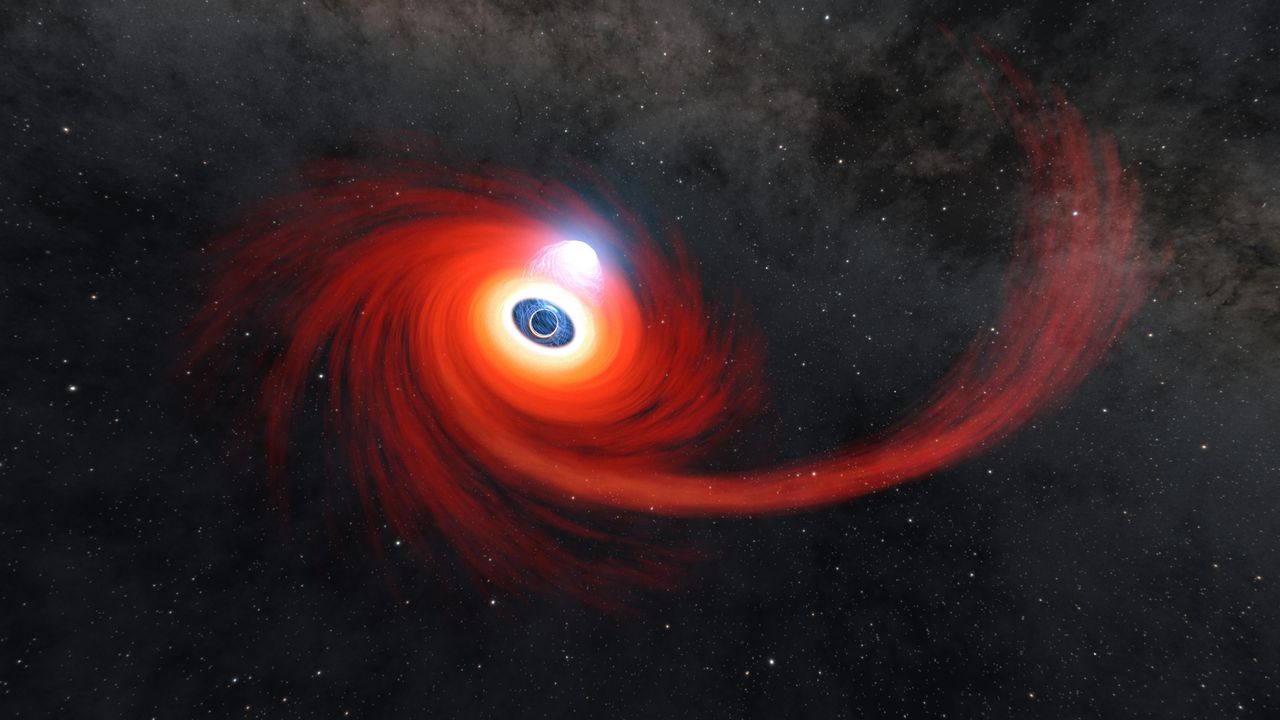
Astronomers using the James Webb Space Telescope detect the most distant "black hole star" ever recorded, offering a groundbreaking glimpse into the universe just 660 million years after the Big Bang. This newly discovered cosmic object, designated as MoM-BH*-1, exists as an isolated entity drifting through deep space during the dawn of time. The breakthrough comes during a high-risk observational survey designed to target faint, ambiguous signals from the edge of the observable universe. By capturing the light of this ancient giant, scientists finally have a clear view of a primordial monster before it integrates into a host galaxy.
Unlike previously observed black hole stars that sit obscured within the bright centers of early galaxies, this specimen is entirely "naked." It exists independently, free from the distracting stellar light of a surrounding galactic home. This isolation allows researchers to confirm that all of its emitted energy originates solely from superheated matter spiraling into the central black hole. Although a thick, protective shroud of gas completely blocks direct views of this feeding frenzy, the intense internal radiation heats the surrounding cloud, causing the entire structure to glow like a massive, cool star. Intriguingly, this lonely giant drifts remarkably close to a young neighboring galaxy, setting the stage for a dramatic cosmic collision and merger estimated to occur in about 100 million years.
This discovery solves a persistent cosmic mystery that began in 2022, when the space telescope first revealed bizarre, compact crimson objects scattered across the early universe. Dubbed "little red dots," these enigmatic structures represent rapidly growing supermassive black holes entombed within colossal dust clouds. Typically, these objects reside at the cores of young galaxies whose light travels for over 12 billion years to reach Earth. Because these host galaxies are incredibly distant and faint, astronomers have struggled to separate the light of the central black hole from the surrounding starlight, leaving the true nature of these red dots open to intense debate.
To understand how these independent objects evolve, researchers simulated the impending merger between the isolated black hole star and its neighboring galaxy. The resulting models demonstrate that once the two entities combine, the system's light signature shifts dramatically. The simulated post-merger spectrum perfectly matches the distinct light profiles of the mysterious little red dots observed elsewhere in the universe. This finding provides the strongest evidence yet that these crimson dots are indeed the product of early black holes cloaked in thick gas envelopes, acting as a crucial evolutionary bridge in cosmic history.
The identification of this pristine, isolated black hole star represents a major leap forward in understanding how the universe's earliest supermassive black holes formed and grew. By observing a black hole star in its purest state, free from galactic interference, astrophysicists can now measure the precise mechanics of how gas feeds these cosmic giants. This breakthrough validates the aggressive, high-risk targeting strategies utilized by modern space observatories, proving that even the most elusive and faint signals can yield revolutionary insights into the structure of the infant cosmos.
Looking ahead, astronomers plan to search for more of these isolated cosmic beacons to determine if they are common features of the early universe or rare anomalies. Future observations will focus on refining chemical models of the surrounding gas clouds to determine how these objects influence the formation of the very first galaxies. As telescope technology continues to peer deeper into the cosmic dawn, these primordial red objects will likely unlock the final secrets of how the universe transitioned from a dark, featureless void into a complex web of stars and galaxies.
Originally reported by Space.com
What's Your Reaction?
 Like
0
Like
0
 Dislike
0
Dislike
0
 Love
0
Love
0
 Funny
0
Funny
0
 Angry
0
Angry
0
 Sad
0
Sad
0
 Wow
0
Wow
0