














Trump Cuts US-South Korea Military Drills After Iran Snub
President Donald Trump announced plans to reduce US-South Korea military drills, citing high costs and Seoul's refusal to join efforts against Iran.

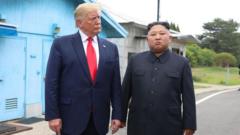
US President Donald Trump announces a significant reduction in upcoming joint military exercises with South Korea, citing his strong personal relationship with North Korean leader Kim Jong Un. The unexpected declaration, made Sunday on social media, comes just hours before the long-planned annual drills are set to begin on Monday. Trump criticizes the maneuvers as both financially burdensome for the United States and unnecessarily provocative toward Pyongyang, signaling a major shift in American defense policy in East Asia.
While Trump acknowledges that the imminent drills are too late to cancel, he targets South Korea for refusing to assist the United States in efforts to denuclearize Iran. The South Korean government is currently reviewing the American president's remarks but maintains that the scheduled military exercises will proceed as planned. This friction occurs shortly after North Korea conducted a series of banned ballistic missile tests, raising regional security anxieties and highlighting the fragile geopolitical balance on the Korean Peninsula.
The sudden policy shift follows Trump's recent public displays of goodwill toward Kim, including sharing a nostalgic photograph of their 2019 summit. Meanwhile, Seoul's presidential Blue House continues to navigate complex diplomatic waters, balancing its alliance with Washington against its own security imperatives. Currently, approximately 28,500 American military personnel remain stationed in South Korea to deter aggression, a presence that Pyongyang consistently denounces as a rehearsal for an invasion of its territory.
Military analysts warn that scaling back these joint operations carries severe strategic risks with minimal financial benefit. Security experts argue that regular combined exercises are vital for maintaining troop readiness and that reducing them could undermine the alliance's overall deterrence capabilities. Furthermore, defense officials recently highlighted new regional threats, including North Korea's deployment of troops to support Russia's war in Ukraine, which the upcoming 11-day Ulchi Freedom Shield drills, involving 18,000 South Korean soldiers, are designed to address.
This decision threatens to disrupt decades of coordinated defense planning between Washington and Seoul at a time of escalating global tensions. By questioning the value of these exercises, Trump risks weakening the United States' commitment to its Asian allies and emboldening adversaries in the region. The move also complicates South Korea's efforts to assume greater responsibility for its own national defense, potentially creating a security vacuum that North Korea or other regional powers could exploit to their advantage.
As the current round of military exercises gets underway, the future of US-South Korea defense cooperation remains highly uncertain. Diplomatic consultations will likely focus on salvaging the alliance's core readiness while addressing Trump's demands for fairer cost-sharing and broader international cooperation. Whether this strategic pivot paves the way for renewed denuclearization talks with Pyongyang or simply erodes the security architecture of East Asia will depend on the diplomatic maneuvering in the coming months.
Originally reported by BBC World
What's Your Reaction?
 Like
0
Like
0
 Dislike
0
Dislike
0
 Love
0
Love
0
 Funny
0
Funny
0
 Angry
0
Angry
0
 Sad
0
Sad
0
 Wow
0
Wow
0