













Fastest Star Ever Found Zooms Around Milky Way Black Hole
Astronomers have discovered S301, the fastest star in the Milky Way, orbiting Sagittarius A* at 8% the speed of light, which could test Einstein's theories.

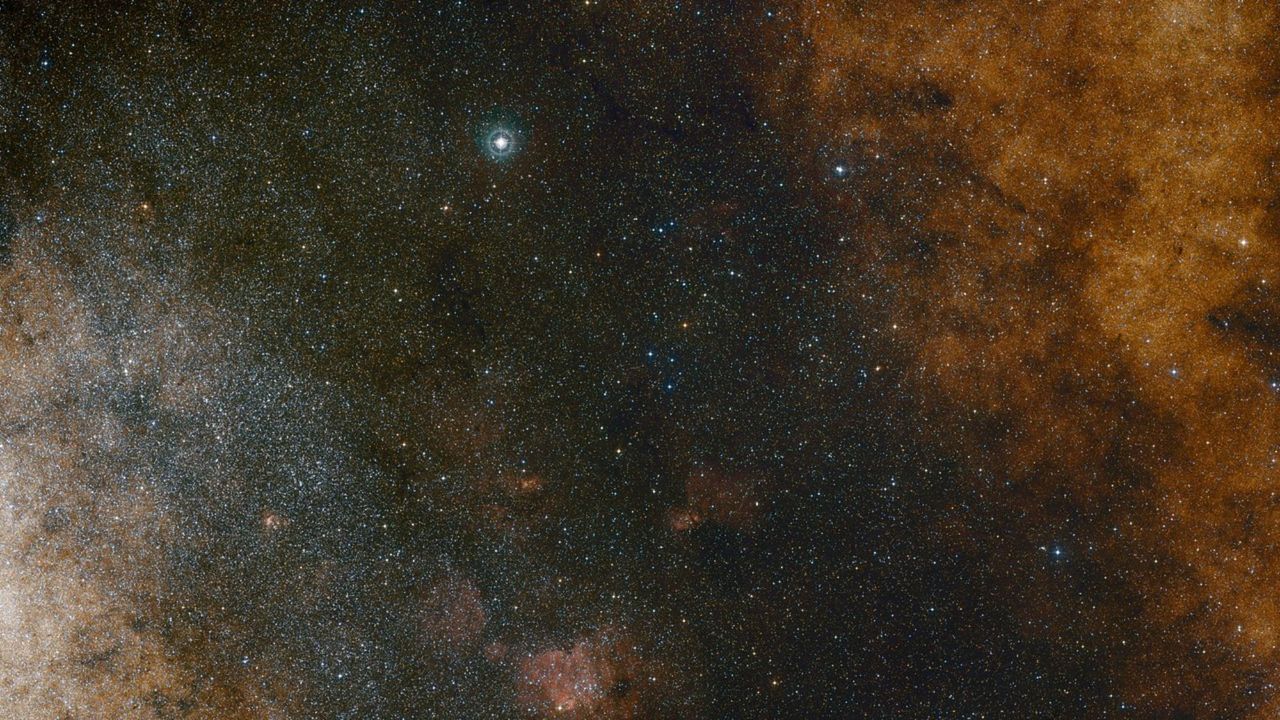
Astronomers have detected the fastest-moving star ever recorded in the Milky Way, a dim stellar object tearing through the galactic center at a staggering fraction of the speed of light. This extreme star, designated S301, orbits Sagittarius A*, the supermassive black hole residing at the heart of our galaxy. Moving at speeds reaching approximately 15,500 miles per second—greater than eight percent of the speed of light—the newly identified star completes a full circuit around the gravitational behemoth in just under nine years. This discovery, made using advanced telescope arrays in Chile, redefines our understanding of stellar dynamics in the most extreme environments of the universe.
S301 travels along an incredibly tight and highly elongated path, bringing it closer to the supermassive black hole than any other known star. At its point of closest approach, the star ventures within a mere 12 times the distance between Earth and the Sun. This proximity is unprecedented for a stellar body orbiting a black hole of this scale, which boasts a mass roughly 4.3 million times that of our Sun. The extreme gravitational forces at play during this close encounter accelerate S301 to its maximum velocity, making it a perfect natural laboratory for studying high-energy astrophysics.
To pinpoint this elusive star, astronomers analyzed data collected by high-precision infrared instruments, tracing the star's trajectory back through observations recorded in 2017 and 2021 before officially identifying it in 2023. The highly eccentric shape of S301’s orbit suggests a dramatic origin story. It likely began its life as part of a binary star system. When the pair wandered too close to the galactic center, the immense gravitational pull of Sagittarius A* disrupted the system, violently ejecting one star into deep space while capturing S301 into its current, tightly bound orbital dance.
This extreme orbital path offers a rare opportunity to test Albert Einstein’s theory of general relativity in a supermassive gravity environment. According to relativity, a rotating black hole drags the very fabric of spacetime along with it as it spins, a phenomenon known as frame dragging or Lense-Thirring precession. Because S301 passes so close to the event horizon of Sagittarius A*, this gravitational warping should gradually shift the star's orbital path over time. Observing these subtle orbital shifts will allow scientists to directly calculate the spin of the supermassive black hole for the first time in history.
Direct measuring of the spin of Sagittarius A* represents a monumental milestone for modern physics and observational astronomy. Until now, estimating the rotational speeds of supermassive black holes has relied on indirect methods and complex modeling. By tracking S301, researchers can bypass these assumptions and gather concrete empirical data. Confirming the presence of frame dragging at this scale will either further validate Einstein's century-old equations or reveal unexpected anomalies that could pave the way for new physics, transforming our understanding of gravity and spacetime.
The scientific community is already preparing for the star's next close approach, which is scheduled to occur in 2031. Over the next decade, next-generation astronomical instruments and extremely large ground-based telescopes will continuously monitor S301. By compiling data spanning two complete orbits, astronomers expect to unlock the final secrets of the black hole's spin. This ongoing observation campaign promises to usher in a new era of high-precision gravity research, turning the chaotic center of our galaxy into the ultimate physics laboratory.
Originally reported by Space.com
What's Your Reaction?
 Like
0
Like
0
 Dislike
0
Dislike
0
 Love
0
Love
0
 Funny
0
Funny
0
 Angry
0
Angry
0
 Sad
0
Sad
0
 Wow
0
Wow
0