























Google DeepMind AI Can Predict Hurricanes Earlier Than Ever
Google DeepMind's new open-source WeatherNext AI model predicts hurricane tracks and intensity earlier using low-resolution data, puzzling researchers.


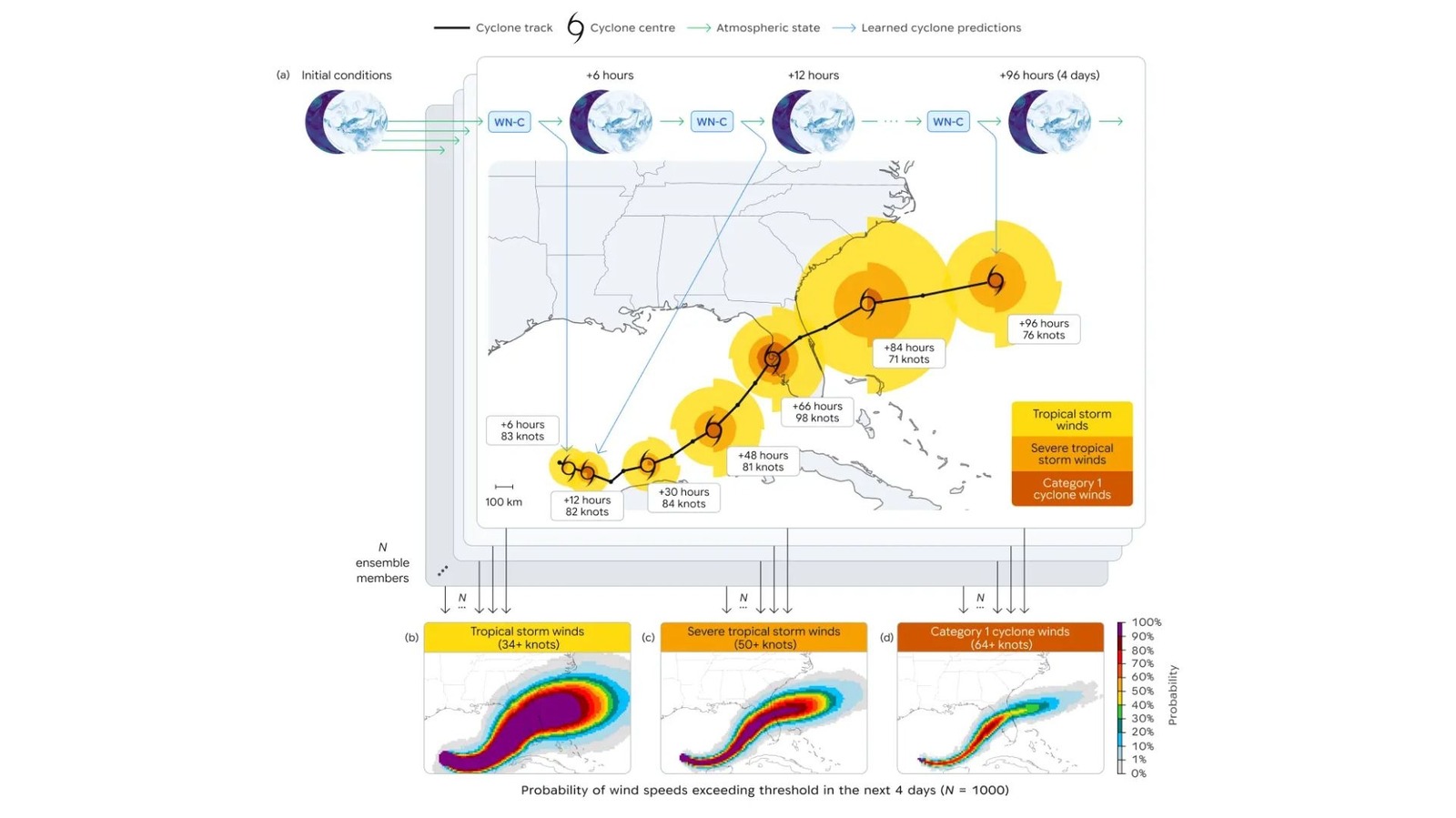
A breakthrough artificial intelligence model called WeatherNext transforms meteorological forecasting this week by predicting both the path and severity of major storms using surprisingly low-resolution data. Developed by a global coalition of computational scientists, this open-source technology delivers highly accurate tracking and intensity forecasts, defying traditional computational requirements. The release marks a pivotal moment in atmospheric science, offering a powerful new tool to meteorologists worldwide just as extreme weather events become more frequent and severe.
Unlike conventional forecasting systems that demand massive supercomputers and high-fidelity data feeds, WeatherNext operates efficiently on significantly degraded inputs. The system processes coarse atmospheric measurements, such as temperature gradients and wind vectors, and translates them into precise projections of a storm's trajectory and wind speeds. Remarkably, the model achieves these results with a fraction of the computational power typically required for advanced meteorological modeling. However, the inner workings of the system remain a mystery, as the developers themselves cannot yet fully explain the exact mathematical pathways the AI uses to generate such precise outputs from low-quality information.
Historically, weather forecasting relies on numerical weather prediction models that simulate physical laws governing the atmosphere. These traditional systems require vast networks of sensors, satellites, and radar stations to feed high-resolution data into multi-million-dollar supercomputers. When data gaps occur, particularly in developing nations or over vast oceans, traditional models often fail to provide timely or accurate warnings. The rise of machine learning in meteorology represents a paradigm shift, moving away from pure physics-based simulations toward pattern-recognition algorithms that can find hidden signals in noisy, incomplete datasets.
Computational experts view this development as a classic example of the "black box" phenomenon in deep learning, where an algorithm produces correct results through processes that are too complex for human observers to trace. While some scientists express caution about relying on a system whose internal logic is not fully understood, others emphasize that the empirical success of the model speaks for itself. Parallel efforts in the tech sector are currently focusing on explainable artificial intelligence to demystify these neural networks, but the immediate practical benefits of WeatherNext are pushing meteorologists to embrace the technology despite the theoretical uncertainties.
The decision to make WeatherNext open-source carries profound implications for global disaster preparedness, particularly in underfunded regions. Developing countries, which often lack the infrastructure to gather high-resolution meteorological data or run expensive supercomputing simulations, can now deploy state-of-the-art storm tracking tools using basic hardware. This democratization of advanced forecasting capabilities has the potential to save thousands of lives by providing earlier, more reliable evacuation warnings for hurricanes, typhoons, and severe tropical depressions.
Looking ahead, researchers plan to conduct extensive real-world testing of WeatherNext during the upcoming tropical storm season to refine its predictive capabilities. At the same time, computer scientists are designing diagnostic tools to peer inside the model's neural layers, hoping to decode the secret behind its efficiency. As the climate crisis continues to fuel unpredictable and violent weather patterns, the integration of these mysterious yet highly effective AI tools will likely define the next generation of global emergency response and climate adaptation strategies.
Originally reported by Wired
What's Your Reaction?
 Like
0
Like
0
 Dislike
0
Dislike
0
 Love
0
Love
0
 Funny
0
Funny
0
 Angry
0
Angry
0
 Sad
0
Sad
0
 Wow
0
Wow
0