













Ukrainian Drones Defeat Russian Tanks' Active Protection Systems
Despite advanced active protection systems designed to shoot down aerial threats, Russian tanks remain highly vulnerable to relentless Ukrainian drone attacks.

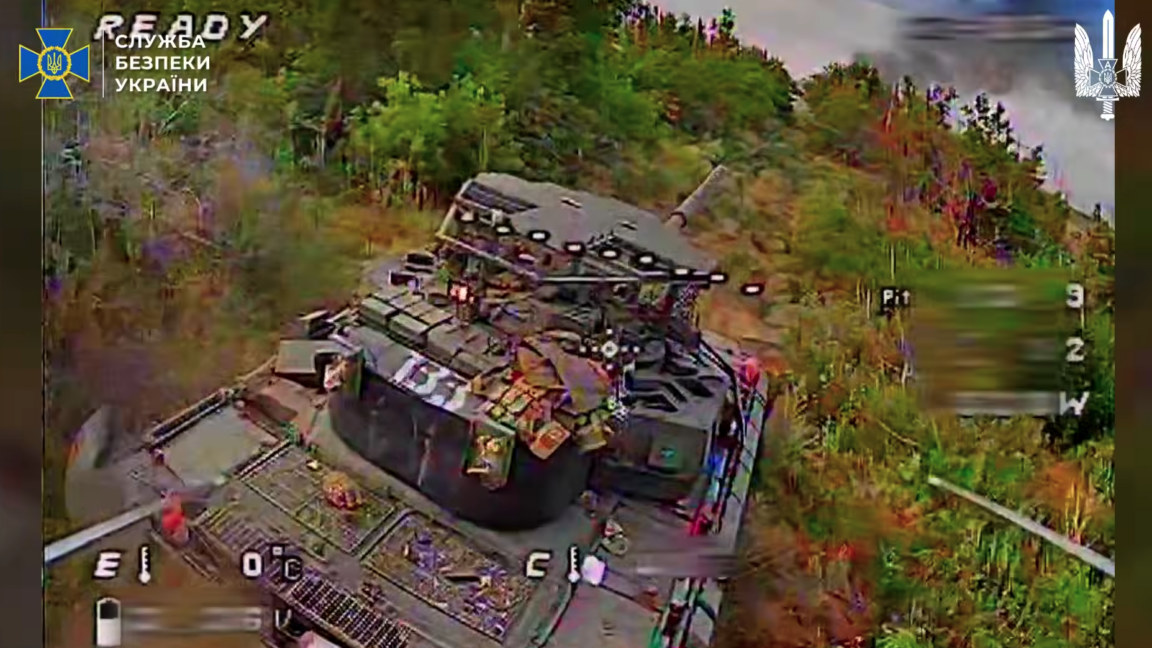
Modern main battle tanks equipped with state-of-the-art anti-drone defense systems are failing to survive on contemporary battlefields in Eastern Europe, as cheap unmanned aerial vehicles continue to bypass advanced armor protections. Despite millions of dollars spent on electronic jamming and physical interception technologies, military forces are discovering this season that even the most heavily fortified armored vehicles remain highly susceptible to low-cost drone strikes. This vulnerability exposes a critical gap in modern mechanized warfare, where multi-million-dollar machines fall victim to off-the-shelf hobbyist drones modified for combat.
The failure of these defensive measures stems from the rapid evolution of drone tactics and technology. While tanks now feature automated jammer pods, explosive reactive armor, and metal cages welded to their turrets, drone operators adapt with alarming speed. Pilots fly highly maneuverable first-person-view drones directly into unprotected gaps, such as the engine compartment or the thin armor underneath the turret ring. Furthermore, electronic warfare systems designed to scramble drone signals often fail when faced with new, frequency-hopping communication protocols or fiber-optic tethered drones that are completely immune to radio interference.
Historically, the tank reigned supreme as the ultimate symbol of land power, designed to withstand direct hits from other tanks and heavy artillery. However, the conflict in Ukraine has fundamentally altered this paradigm, turning the airspace just above the trenches into a lethal gauntlet. Over the past two years, both sides have deployed hundreds of thousands of small, explosive-laden quadcopters, transforming a tool once used for aerial photography into a precision-guided weapon. This shift forces military engineers to rush experimental defensive suites to the front lines, bypassing traditional procurement and testing cycles.
Military analysts point out that current active protection systems, which use radar to detect incoming projectiles and launch small countermeasures to destroy them, are optimized for fast-moving anti-tank missiles rather than slow, hovering drones. These systems often struggle to distinguish a loitering drone from ground clutter, leaving the tank blind to the threat. Additionally, the sheer volume of drone attacks can easily saturate a tank's defensive capabilities, exhausting its limited supply of counter-munitions and leaving it defenseless against subsequent waves of aerial assaults.
This persistent vulnerability has profound implications for global military strategy and defense spending. Governments worldwide question the utility of investing heavily in heavy armor when a five-hundred-dollar drone can neutralize an eight-million-dollar tank. The loss of armored dominance forces infantry units to operate without direct fire support, slowing down offensive operations and turning battles into grinding wars of attrition. Consequently, defense contractors face intense pressure to redesign armored vehicles from the ground up, rather than simply slapping retrofitted defenses onto legacy platforms.
Looking ahead, the race between armored protection and aerial assault will drive the integration of artificial intelligence and directed-energy weapons. Future tanks may rely on automated laser systems capable of tracking and neutralizing multiple drone swarms simultaneously in milliseconds. Until these next-generation technologies mature and reach the battlefield, armored crews must continue to rely on improvised defenses and tactical caution. The era of undisputed tank dominance is over, and the future of land warfare belongs to whoever can successfully control the immediate airspace.
Originally reported by Ars Technica
What's Your Reaction?
 Like
0
Like
0
 Dislike
0
Dislike
0
 Love
0
Love
0
 Funny
0
Funny
0
 Angry
0
Angry
0
 Sad
0
Sad
0
 Wow
0
Wow
0