



















Pluto's Atmosphere is Collapsing as It Drifts Away From Sun
Astronomers observe Pluto's atmosphere starting to collapse and freeze into frost as the dwarf planet drifts further away from the sun in its orbit.

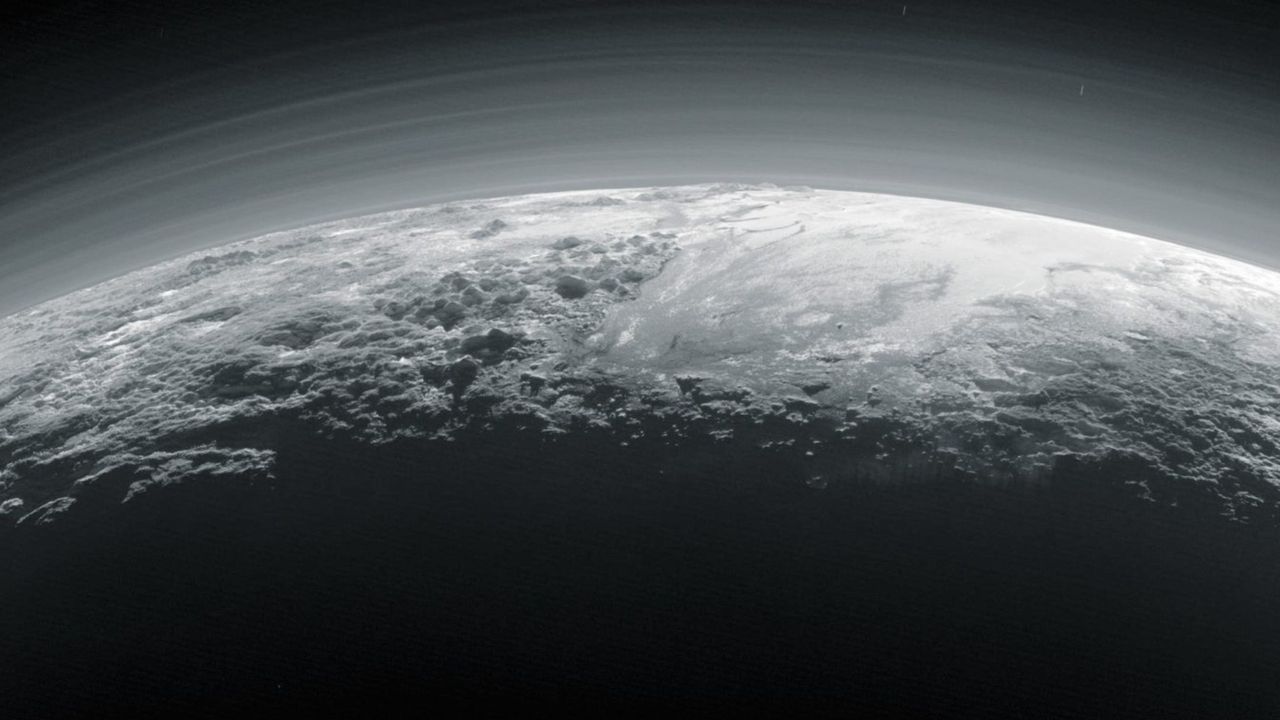
Astronomers monitoring the outer reaches of the solar system detect a dramatic shift on Pluto as the dwarf planet's thin atmosphere begins to freeze and collapse. Recent observations of Pluto passing in front of distant stars reveal a measurable drop in atmospheric pressure, indicating that the nitrogen-rich air is condensing into frost on the frigid surface. This cosmic transition, recorded during a series of stellar alignments over the last several years, marks a critical phase in the distant world's seasonal cycle as it retreats further into the cold depths of space.
The dwarf planet already experiences extreme temperatures, with a surface that hovers around minus 382 degrees Fahrenheit and an upper atmosphere that is only slightly warmer at minus 333 degrees Fahrenheit. As Pluto distances itself from the warmth of the Sun, these temperatures plunge even lower, triggering the atmospheric collapse. The nitrogen gas, which also contains traces of methane and carbon monoxide, transitions directly into solid ice. This atmospheric decay represents a significant drop from the incredibly faint ten microbars of pressure recorded during a historic spacecraft flyby in mid-2015.
Pluto travels along a highly eccentric, 248-year orbit that is tilted sharply compared to the rest of the solar system. During its closest approach to the Sun in 1989, the dwarf planet actually crossed inside the orbit of Neptune, temporarily becoming closer to the Sun than the gas giant. Since that peak, Pluto has been steadily marching outward toward its most distant orbital point, which it will not reach until the year 2114. Humanity has yet to witness even a single complete orbit of Pluto since its discovery in 1930, making each phase of its long journey a brand-new scientific event.
With no spacecraft currently near Pluto, researchers must rely on ground-based observations to track these atmospheric changes. Scientists achieve this by watching Pluto pass directly in front of distant stars, an event known as a stellar occultation. Unlike airless space rocks that block starlight instantly, Pluto's atmosphere causes the light of the background star to fade gradually as the air scatters and bends the incoming rays. Analyzing ten of these rare alignments between 2017 and 2023 provides the precise data needed to map the declining density of the alien sky.
This ongoing atmospheric collapse offers a rare, real-time look at planetary evolution and seasonal change on a global scale. Understanding how Pluto's nitrogen envelope behaves during its retreat provides vital clues about volatile transport and ice distribution on icy bodies across the Kuiper Belt. The transition from a gaseous atmosphere to a frozen surface layer alters the planet's reflectivity and thermal balance, reshaping its entire environment. These findings challenge previous assumptions about how long Pluto could retain its atmosphere after its closest solar approach.
As Pluto continues its century-long journey toward its furthest point nearly five billion miles away, its atmosphere will likely vanish almost entirely, leaving a bare, frozen sphere. Astronomers will continue to chase the narrow shadows of stellar occultations across Earth to document the final stages of this atmospheric freeze-out. These challenging observations will remain the primary tool for monitoring the dwarf planet's transformation until a future space mission returns to the dark edges of the solar system.
Originally reported by Space.com
What's Your Reaction?
 Like
0
Like
0
 Dislike
0
Dislike
0
 Love
0
Love
0
 Funny
0
Funny
0
 Angry
0
Angry
0
 Sad
0
Sad
0
 Wow
0
Wow
0