


.jpg)

















This Week in Space: SpaceX Starship Flight 13 Floats in Ocean
Listen to This Week in Space Episode 221 to hear about SpaceX's Starship Flight 13 floating in the ocean, NASA's Roman Space Telescope, and Boeing delays.

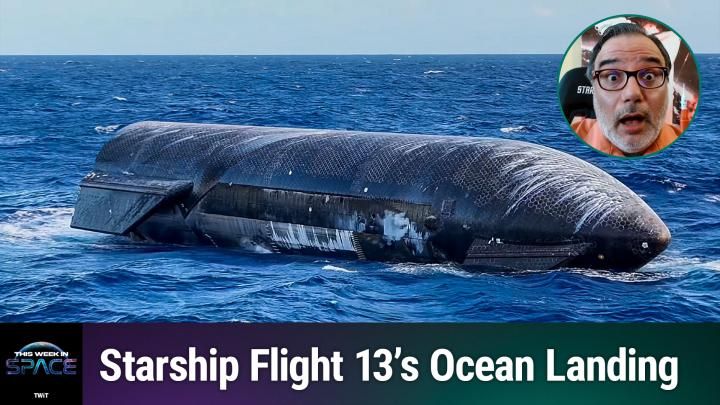
The global space sector undergoes a dramatic transformation this week as SpaceX achieves a historic milestone with its Starship Flight 13 mission, alongside critical developments from NASA and international private aerospace firms. From the waters of the Pacific Ocean to launchpads in India, a series of high-stakes missions redefine modern orbital capabilities. SpaceX leads the charge by successfully deploying next-generation Starlink satellites and demonstrating unprecedented spacecraft durability during a dramatic ocean splashdown.
During this latest test flight, the massive Starship vehicle successfully deploys advanced Starlink V3 satellites into orbit before braving the extreme heat of atmospheric reentry. In a surprising display of resilience, the spacecraft survives the descent intact and remains floating in the ocean for several days. Meanwhile, NASA prepares for the imminent launch of the Nancy Grace Roman Space Telescope, scheduled to lift off in just one month. Simultaneously, engineers scramble to resolve technical anomalies plaguing a servicing spacecraft sent to rescue the aging Swift Space Observatory, adding tension to an already complex orbital salvage operation.
These rapid developments occur against the backdrop of an increasingly crowded and commercialized low Earth orbit. For years, the aerospace industry relied on expendable rockets and government-funded missions, but the paradigm is shifting rapidly toward reusable infrastructure and private enterprise. SpaceX’s continuous iteration of its Starship platform represents the vanguard of this movement, aiming to drastically lower the cost of reaching space. At the same time, legacy scientific instruments like the Swift Observatory, which has monitored high-energy cosmic events since 2004, require innovative servicing solutions as they outlive their original design lifespans.
Industry analysts point out that while some players achieve rapid success, others face persistent hurdles in this new space age. Boeing continues to grapple with ongoing delays for its Starliner capsule, highlighting the immense engineering challenges of human-rated spaceflight. Conversely, the global market is expanding with new competitive players, highlighted by India's successful deployment of the Vikram-1 rocket. Developed by Skyroot Aerospace, this mission marks India's first successful private orbital launch, signaling a major shift in the country's domestic space ecosystem and proving that private launch capabilities are no longer exclusive to Western firms.
The successful survival of the Starship vehicle post-reentry proves that fully reusable, rapid-turnaround spacecraft are closer to reality than ever before. This capability will fundamentally alter the economics of satellite deployment and deep-space exploration. Furthermore, the upcoming deployment of the Roman Space Telescope promises to revolutionize astrophysics by providing panoramic views of the universe to hunt for dark energy and exoplanets. On a geopolitical scale, the rise of private launch providers in nations like India democratizes access to space, fostering international competition and driving down costs for global consumers.
Looking ahead, the pace of space exploration shows no signs of slowing down as public agencies and private entities prepare for the next giant leaps. The lessons learned from Starship's maritime survival will directly inform upcoming lunar and Martian transport designs. As NASA resolves its current robotic servicing challenges and launches its next-generation observatories, humanity stands on the verge of unprecedented cosmic discoveries. The coming months will test the resilience of these new technologies, paving the way for a permanent human presence beyond Earth and a highly interconnected global space economy.
Originally reported by Space.com
What's Your Reaction?
 Like
0
Like
0
 Dislike
0
Dislike
0
 Love
0
Love
0
 Funny
0
Funny
0
 Angry
0
Angry
0
 Sad
0
Sad
0
 Wow
0
Wow
0