
.jpg)














Europe Drought: Rhine River Falls to Record Low Water Levels
The River Rhine and other major European waterways hit record low water levels amid prolonged heatwaves, threatening shipping and economic activity.

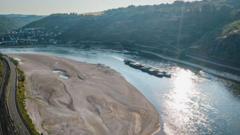
Record-breaking summer heatwaves push Europe's vital waterways to historic lows, crippling shipping lanes and threatening energy grids across the continent. The River Rhine plunged to its lowest levels ever recorded at key monitoring points in Germany and the Netherlands this week, as a relentless drought bakes central and western Europe. From the industrial hubs of western Germany to the delta in the Netherlands, the drying riverbeds signal a deepening environmental crisis that is rapidly transforming into an economic emergency. This unprecedented decline in water levels affects not only the Rhine but also other major continental arteries, including the Danube and the Po, as temperatures consistently soar past 40 degrees Celsius.
Specific monitoring stations reveal the severity of the crisis, with water levels in Cologne and Lobith dropping past previous historical thresholds. At the critical transit chokepoint of Kaub, near Koblenz, the navigable depth recently bottomed out at a mere 25 centimeters, matching a previous historic low. Official data shows that nearly 44 percent of measuring stations along the Rhine and an alarming 78 percent of those on the Danube are currently reporting extremely low water levels. These shallow depths prevent large cargo vessels from navigating safely, forcing operators to drastically reduce their loads to avoid running aground.
Running from the Swiss Alps to the North Sea, the Rhine serves as the industrial backbone of Europe, carrying millions of tons of freight annually. The current crisis stems from months of below-average rainfall coupled with successive heatwaves that have parched the European continent since mid-summer. European drought monitoring agencies classify the soil conditions across much of central and western Europe as critical, with no signs of immediate relief. As the ground bakes, the lack of runoff fails to replenish these essential river basins, exposing the vulnerability of the continent's transport and energy infrastructure to extreme weather events.
Shipping officials explain that while a total halt to river traffic remains unlikely, logistics companies must adapt by distributing cargo across multiple smaller vessels. This strategy keeps boats afloat but drastically reduces efficiency, leading to a situation where some shipments are no longer financially viable for traders. Meanwhile, the crisis extends far beyond transport, severely disrupting the European energy sector. The depleted Danube, currently at a 30-year low in Eastern Europe, has forced Hungary to suspend operations at its sole nuclear power plant due to a lack of cooling water. Similarly, neighboring Serbia has scaled back coal-fired power generation, and Romanian authorities have resorted to controlled explosions on river obstructions to maintain flow.
The economic ramifications of these dry riverbeds ripple through global supply chains, driving up transport costs and threatening to cause severe supply bottlenecks for essential goods. Industries reliant on cheap river transport for coal, chemicals, and grain now face expensive alternatives like rail or road, which are already operating at capacity. Furthermore, the simultaneous squeeze on electricity generation from both nuclear and coal facilities exacerbates an already tense European energy market. With key transport routes choked and power grids strained, the drought threatens to stall industrial production and fuel inflation across the eurozone.
Relief remains far on the horizon as meteorological forecasts predict another week of intense heat and dry conditions across central and southern Europe. Without significant, sustained rainfall to replenish the headwaters, river levels will likely remain depressed, prolonging the logistical and energy crises into the autumn. Governments and industries now face the harsh reality of climate adaptation, recognizing that these once-rare seasonal droughts may become the standard operational environment. As Europe braces for continued scorching temperatures, the race to secure alternative supply routes and resilient energy sources becomes more urgent than ever.
Originally reported by BBC World
What's Your Reaction?
 Like
0
Like
0
 Dislike
0
Dislike
0
 Love
0
Love
0
 Funny
0
Funny
0
 Angry
0
Angry
0
 Sad
0
Sad
0
 Wow
0
Wow
0