


.jpg)













Scientists Discover First 'Three-Headed' Asteroid Nysa
New images of asteroid (44) Nysa reveal a unique three-headed shape and a tiny orbiting moon, offering scientists fresh clues about solar system history.

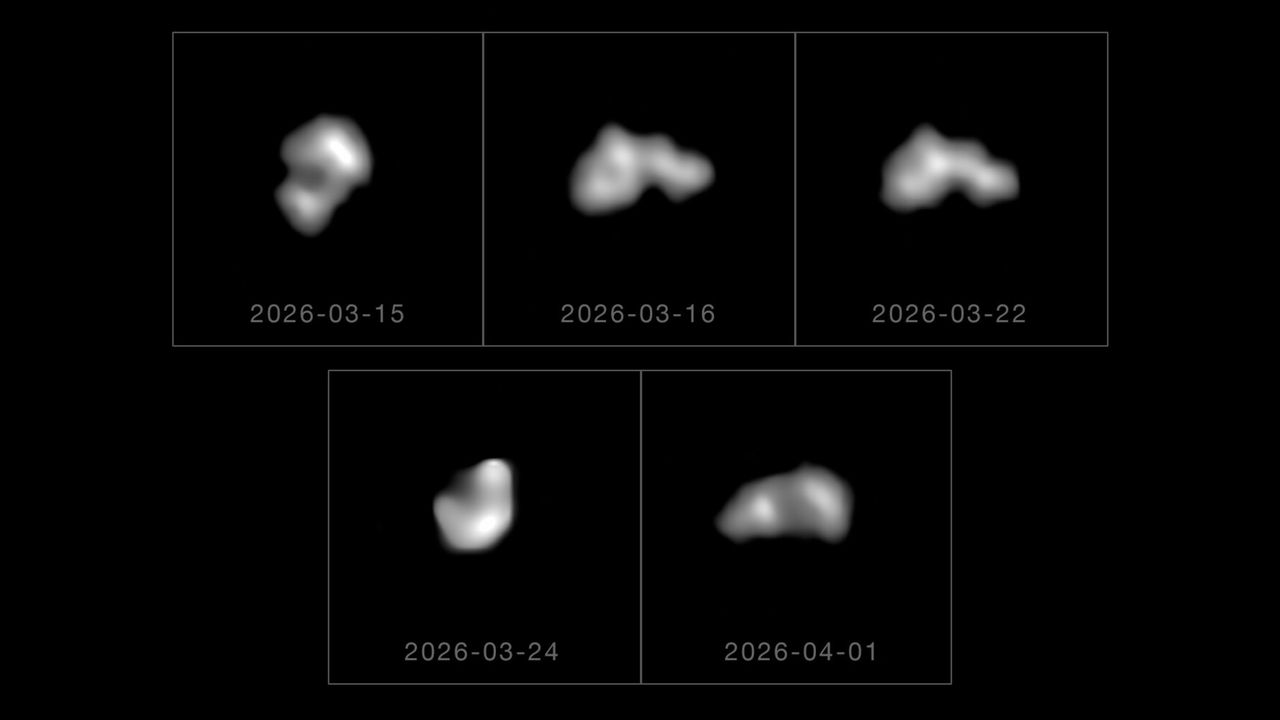
Groundbreaking new images from premier observatories in Chile and Arizona reveal the first-known "trilobate" or three-headed asteroid in our solar system. This bizarre space rock, designated as (44) Nysa, currently spins through the main asteroid belt situated between Mars and Jupiter. While astronomers first spotted the asteroid in the mid-nineteenth century, these latest high-resolution observations finally resolve its unprecedented triple-lobed structure, marking a historic milestone in planetary science.
The newly captured data shows that Nysa spans approximately 47 miles at its widest point, featuring a highly unusual shape defined by two distinct, narrow necks that connect three bulbous lobes. Even more surprising is the discovery of a tiny companion moon orbiting the asteroid. This miniature satellite, designated S/2026 (44) 1, measures just over half a mile wide and circles the main three-headed body at a distance of roughly 106 miles, creating a complex gravitational system unlike any other observed in the asteroid belt.
Although Nysa has been on the scientific radar since its initial discovery in 1857, its true physical form remained a mystery for over a century and a half due to the limitations of older imaging technology. The breakthrough comes courtesy of the Very Large Telescope in Chile and the Large Binocular Telescope in Arizona, which utilize state-of-the-art optics to cut through cosmic distortion. These powerful instruments allow researchers to peer deep into the asteroid belt and map the precise geometry of distant, dim objects that previously appeared as mere points of light.
Planetary scientists analyze these striking images to determine the origin of Nysa's unique architecture. The prevailing theories suggest the asteroid is either a contact trinary—a cluster of three separate space rocks fused together by gentle gravitational collisions—or an incredibly irregular, single coherent body shaped by ancient impacts. This structural mystery challenges existing models of asteroid evolution and suggests that the dynamics of the early solar system were far more chaotic and creative than previously thought.
Investigating unusual objects like Nysa provides invaluable clues about the primordial environment of our cosmic neighborhood. Because Nysa belongs to a specific class of asteroids that likely originated much closer to the sun, its chemical makeup closely mirrors the raw materials that formed rocky planets like Earth, Mars, and Venus. By studying this three-headed relic, researchers can effectively peer back in time to analyze the fundamental building blocks that initiated planet formation billions of years ago.
Moving forward, astronomers plan to conduct follow-up observations to track the orbit of Nysa's tiny moon and refine their measurements of the asteroid's mass and density. These future studies will help determine whether Nysa is a fragile rubble pile or a solid metallic remnant from the dawn of the solar system. As next-generation telescopes come online, the study of this triple-lobed anomaly promises to reshape our understanding of how matter behaves and clusters in the deep reaches of space.
Originally reported by Space.com
What's Your Reaction?
 Like
0
Like
0
 Dislike
0
Dislike
0
 Love
0
Love
0
 Funny
0
Funny
0
 Angry
0
Angry
0
 Sad
0
Sad
0
 Wow
0
Wow
0