
















NASA's Perseverance Rover Breaks Mars Self-Driving Record
NASA’s Perseverance rover is set to break the Mars distance record, thanks to its advanced self-driving auto-navigation system that outpaces older rovers.

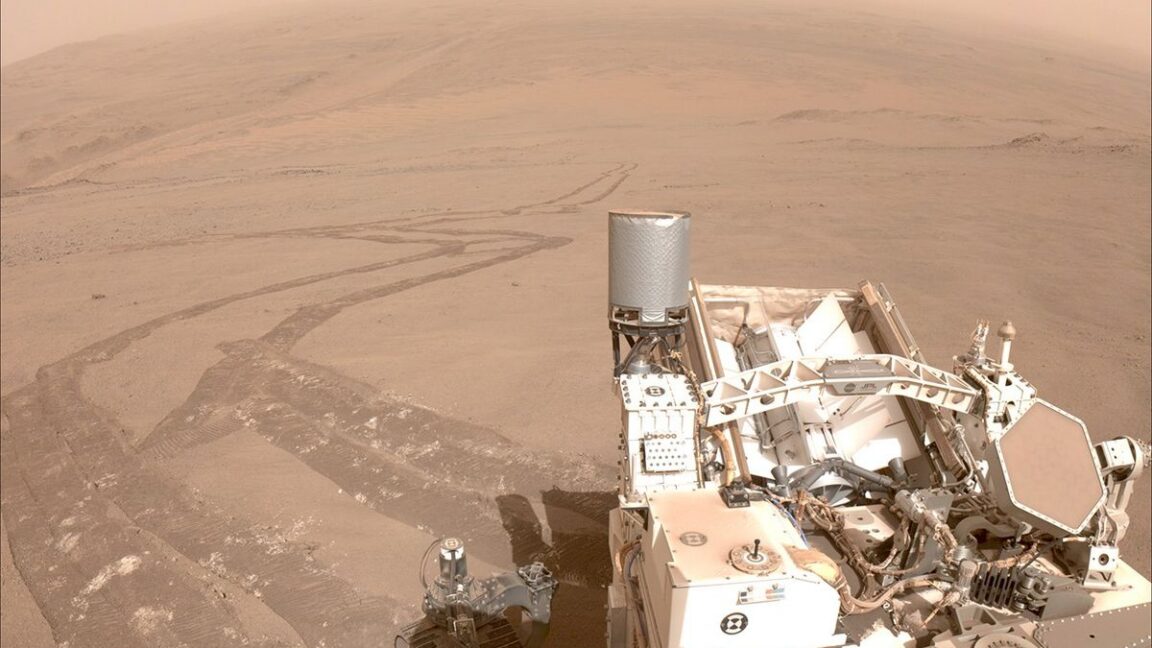
A robotic explorer on Mars is poised to make history next week by breaking the record for the farthest distance ever driven on another world. The car-sized Perseverance rover, which has been exploring the red planet since early 2021, is set to surpass the previous driving record of 45.16 kilometers (28.06 miles). This milestone officially crowns the active explorer as the most well-traveled vehicle in space history, eclipsing a record that stood for years.
What makes this achievement remarkable is the unprecedented speed with which the machine reached this milestone, accomplishing the feat in just a third of the time of its predecessors. The key to this rapid transit lies in an advanced, self-driving navigation system. Utilizing high-resolution onboard cameras and a powerful computer, the rover constantly maps the rugged Martian terrain, automatically plotting the safest path around hazards like steep sandy slopes and sharp boulders. Unlike older models, this vehicle can process visual data and calculate its route in real-time while its wheels are actively turning, maintaining a steady maximum speed of 150 meters per hour.
The previous distance record belonged to the legendary Opportunity rover, which fell silent in 2018 after nearly fifteen years of Martian exploration. Meanwhile, another active sibling rover, Curiosity, has covered 38.6 kilometers over more than a decade on the planet. While Curiosity possesses similar imaging tools, its older computer processors—relying on technology dating back to the 1990s—limit its self-driving capability to just ten percent of its total travel. Consequently, Curiosity must frequently halt to wait for human drivers on Earth to beam down navigation commands, whereas the newer explorer operates autonomously about ninety percent of the time.
While self-driving cars on Earth benefit from paved roads, traffic signs, and GPS, navigating an alien world presents entirely unique challenges. Without a global navigation network or clear pathways, the robotic explorer must rely entirely on its internal algorithms to survive. This autonomous capability has transformed how science is conducted on Mars. Instead of spending days waiting for instructions from millions of miles away, the vehicle can independently navigate complex landscapes, frequently arriving at high-priority research sites ahead of schedule.
This mobility has a profound impact on the scientific output of the mission. While older missions focused on slowly climbing single geological features, this current expedition targets Jezero Crater, an ancient lakebed where points of interest are widely scattered. The ability to quickly traverse vast distances allows the onboard laboratory to investigate a diverse array of geological formations, search for signs of ancient microbial life, and collect rock samples across a much larger geographic area than was ever possible before.
Looking ahead, this record-breaking journey sets a new standard for future interplanetary exploration. As the rover continues to push deeper into unexplored Martian territory, the data gathered from its autonomous navigation will directly influence the design of next-generation space vehicles. Future missions to the Moon, Mars, and beyond will undoubtedly rely on even more sophisticated self-driving systems, paving the way for faster, safer, and more ambitious scientific discoveries across the solar system.
Originally reported by Ars Technica
What's Your Reaction?
 Like
0
Like
0
 Dislike
0
Dislike
0
 Love
0
Love
0
 Funny
0
Funny
0
 Angry
0
Angry
0
 Sad
0
Sad
0
 Wow
0
Wow
0