
















Mount Toba Eruption Didn't Nearly Wipe Out Humans, Study Says.
A new study of the massive Mount Toba eruption 74,000 years ago suggests the volcanic winter lasted under two years and did not threaten human survival.

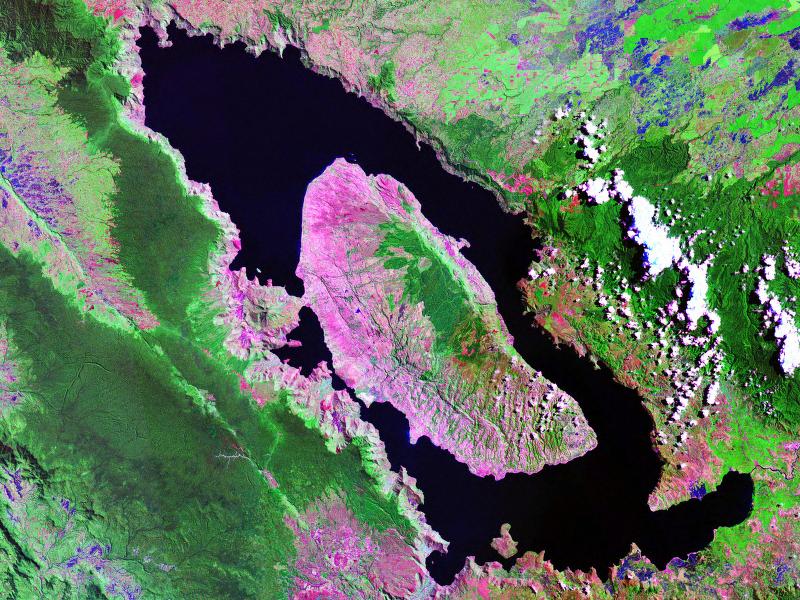
A groundbreaking geological discovery in East Africa reveals that the super-eruption of Mount Toba 74,000 years ago did not trigger a global volcanic winter or threaten early human survival. By analyzing pristine sediment layers from a deep crater lake on the Kenya-Tanzania border, researchers demonstrate that the massive Indonesian eruption caused only minor global cooling that subsided in less than two years. This finding challenges the long-held theory that the prehistoric catastrophe pushed humanity to the brink of extinction.
The Mount Toba eruption stands as the largest volcanic event of the last 2.6 million years, expelling thousands of cubic kilometers of magma in just two weeks. While previous climate models suggested this colossal blast plunged the Earth into a decade-long ice age, the new lake core data paints a much milder picture. The geological record indicates that global temperatures dropped by a mere half a degree Celsius. This brief cooling period proved to be a minor environmental disturbance rather than a cataclysmic threat to our evolutionary ancestors.
Scientists previously struggled to accurately measure the ancient eruption's impact due to the physical limitations of standard geological archives. Volcanic eruptions release massive quantities of sulfur dioxide, which forms a reflective haze in the stratosphere and blocks sunlight. However, computer simulations yielded wildly conflicting results, ranging from mild seasonal shifts to near-extinction scenarios, because researchers lacked precise physical evidence. Standard ocean and lake sediment cores suffer from natural mixing over time, making it nearly impossible to isolate short-term climate events that last only a few years.
Geoscientists resolve this dating dilemma by shifting their focus to the unique physics of massive volcanic plumes. When an eruption exceeds a certain threshold, the resulting sulfate aerosols clump together into larger, heavier particles. Instead of remaining suspended in the atmosphere to reflect sunlight over several years, these heavy droplets rapidly fall back to Earth. This self-limiting mechanism explains why even a super-eruption like Toba fails to produce the prolonged, devastating volcanic winters often depicted in apocalyptic theories.
The breakthrough relies on the exceptional preservation qualities of Lake Chala, a steep-sided crater lake nestled on the slopes of Mount Kilimanjaro. Because the lake's deep waters remain undisturbed by currents and devoid of oxygen, the sediment settles in distinct annual layers called varves. This geological phenomenon acts as a high-resolution stopwatch, preserving a year-by-year record of the ancient climate. Accessing this pristine archive allows science to finally bypass the blurry, decade-scale resolution of typical marine cores and capture the immediate aftermath of prehistoric disasters.
This discovery reshapes the understanding of human resilience and planetary history, prompting a reevaluation of how ancient climate shifts influenced human migration out of Africa. Researchers now plan to apply this high-resolution varve analysis to other major geological events to better predict how the modern atmosphere might react to extreme volcanic activity. By unlocking the precise timelines of past catastrophes, science gains a clearer understanding of both our evolutionary past and the true limits of Earth's climate vulnerability.
Originally reported by Ars Technica
What's Your Reaction?
 Like
0
Like
0
 Dislike
0
Dislike
0
 Love
0
Love
0
 Funny
0
Funny
0
 Angry
0
Angry
0
 Sad
0
Sad
0
 Wow
0
Wow
0