


.jpg)













How Supermassive Black Holes Grow: AI Finds 7 Rare Quasars
Astronomers using AI have discovered seven rare lensed quasars. These cosmic magnifying glasses could reveal how supermassive black holes grow and evolve.

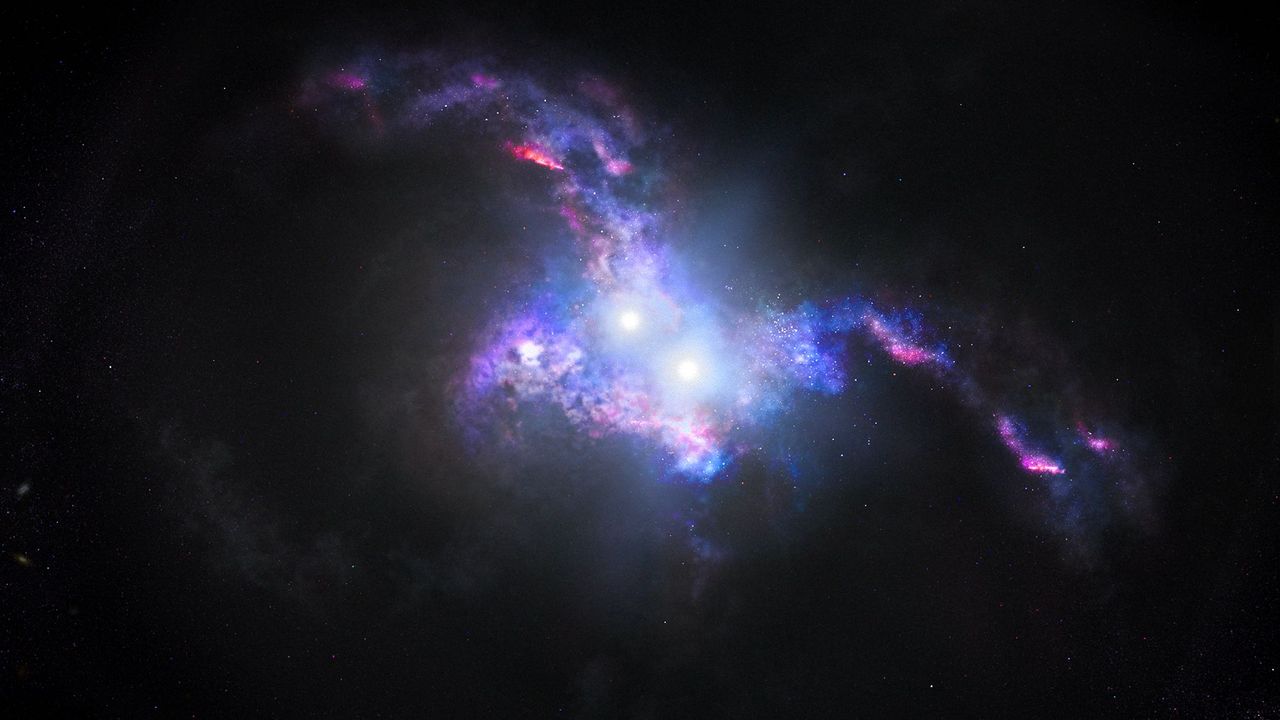
Astronomers discover seven rare cosmic alignments where supermassive black holes act as giant magnifying glasses, bending light from distant galaxies. Utilizing artificial intelligence to analyze data from a massive sky survey, researchers locate these elusive phenomena, known as lensing quasars. This breakthrough, achieved through advanced machine-learning algorithms, offers a powerful new method for studying the earliest stages of galactic evolution and the growth of the universe's most massive objects.
To uncover these rare celestial configurations, scientists analyze a vast catalog containing approximately 800,000 known quasars. Because confirmed lensing quasars are incredibly scarce, the team trains a machine-learning model using simulated data of what these alignments should look like. The trained algorithm successfully narrows the massive dataset down to roughly 200 potential candidates. From there, researchers manually inspect the results, ultimately identifying seven highly promising systems that nearly double the number of such known cosmic structures.
Quasars represent the extremely luminous cores of active galaxies, powered by supermassive black holes feeding on surrounding gas and dust. As these black holes consume matter, they release torrents of energy that outshine all the stars in their host galaxies combined. This blinding glare makes it nearly impossible for astronomers to study the surrounding galactic structures. Gravitational lensing bypasses this obstacle, occurring when the immense gravity of a foreground object bends and amplifies the light of a background galaxy, revealing details otherwise lost in the darkness.
Astrophysicists view quasars as cosmic time capsules, offering a glimpse into the infancy of supermassive black holes. Understanding how these ancient, hyperactive objects transition into the quiet, massive black holes found in modern galaxies remains a central question in cosmology. By studying instances where a quasar acts as a gravitational lens, scientists can simultaneously analyze the active black hole and the magnified background galaxy. This dual observation provides critical data on mass distribution and the rate of cosmic expansion.
This discovery highlights the transformative role of artificial intelligence in modern astronomy, where telescopes generate more data than human researchers can ever hope to process manually. The success of this search demonstrates that machine-learning algorithms can identify incredibly rare phenomena hidden deep within millions of observations. By unlocking these hidden gems, technology bridges the gap between raw observational data and profound scientific discovery, paving the way for a new era of automated space exploration.
Looking ahead, astronomers plan to conduct follow-up observations using powerful ground- and space-based telescopes to confirm the seven candidate lenses. Verification of these systems will allow researchers to measure the properties of the host galaxies and test current models of dark matter. As ongoing sky surveys continue to map the cosmos, the integration of AI tools will undoubtedly reveal more of these cosmic magnifying glasses, reshaping our understanding of how the universe evolved from its chaotic youth into its structured present.
Originally reported by Space.com
What's Your Reaction?
 Like
0
Like
0
 Dislike
0
Dislike
0
 Love
0
Love
0
 Funny
0
Funny
0
 Angry
0
Angry
0
 Sad
0
Sad
0
 Wow
0
Wow
0